Psalms
Book Introduction
With a mixture of authors and messages, the book of Psalms is an inspirational book for all to appreciate and relate to. There are many types of Psalms (e.g. Royal Psalms, laments, prayers, hymns or songs of praise, songs of thanksgiving, songs of Zion, etc.), and each has its own special place and message(s). When reading these psalms, we can listen to the messages, think about what the original author was experiencing, and contemplate how it relates to ourselves, and most importantly, our Creator. Waltner (2006) describes the book of Psalms as “a treasury of experiences accumulated by generations of people who nourished their hopes and anxieties as they clung to their values and their faith in God. As such, the psalms contain and reflect on a wide range of topics” (p. 19).
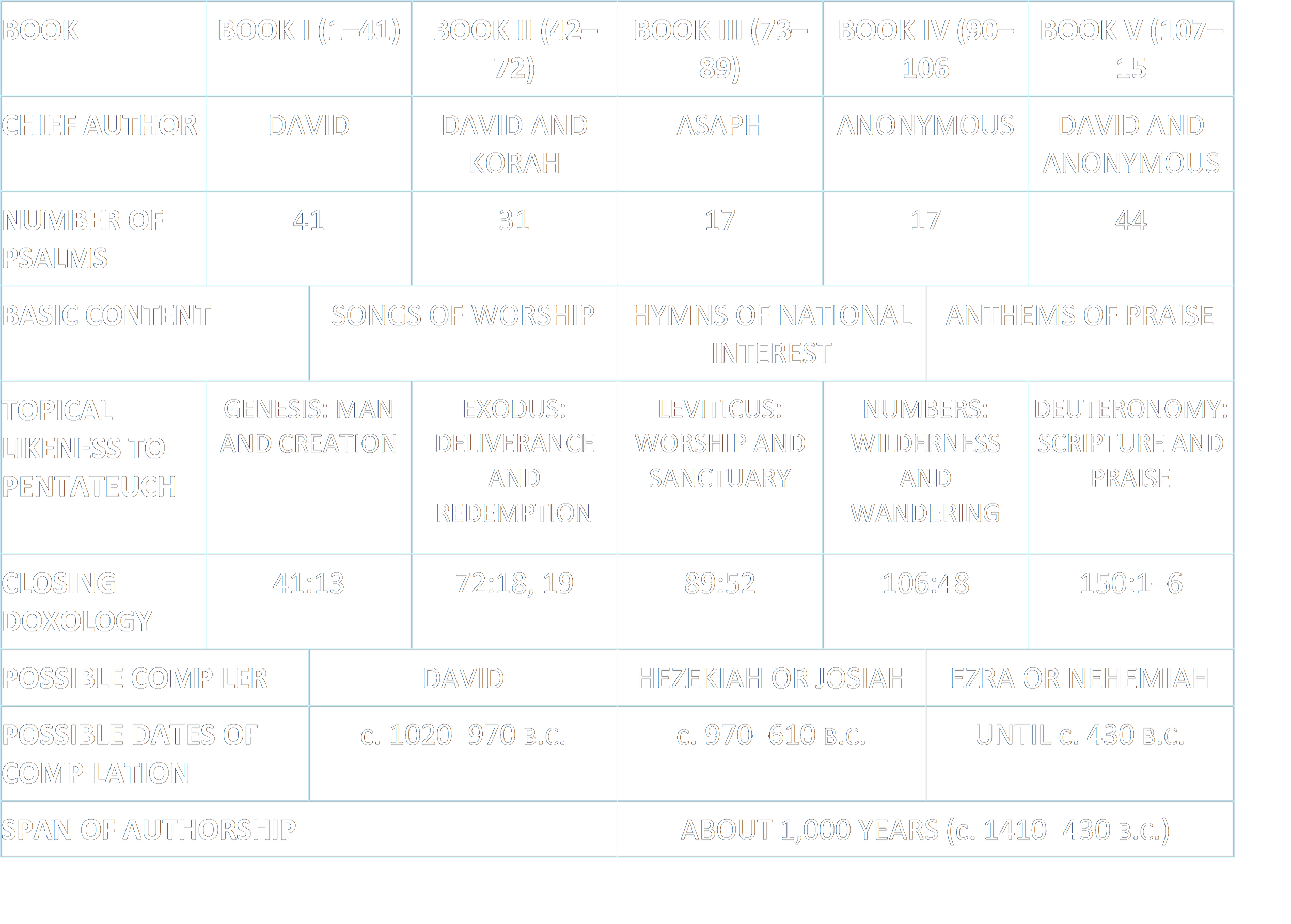
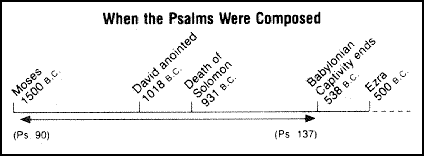
While scholarship does not agree on the details of every psalm, below is a general table that summarizes basic background information.
Psalms at a Glance
How to Read the Psalms
Scholars have recognised various key theological themes in the Psalms. Tucker (2008), for instance, suggests: Yahweh as king, Yahweh as refuge, Yahweh as creator, and enemies. Waltner (2006) sees the following themes: the Lord as refuge, the incomparable God, God the king, the human situation, the community of the people of God, the vitality of worship, the Psalms as Scripture, and instruction and obedience. I now pose the question, when reading the Psalms what themes do or will you see? To give you some guidance, ensure that what you see is not limited by a specific categorical theme such as “God is our refuge.” It is more than just acknowledging the lesson of God is our refuge. For most of you, the principle of God being our refuge is nothing new. So, allow the poetry to take you deeper and explore!
What does refuge mean? How has God been your refuge now and in the past, and how does this relate to the future? What could God as a refuge mean for others? How do others need refuge in God? Who are you praying for, or could you be praying for? For instance, there may be people in a country (individuals and groups) who would benefit from your prayers for them. Apply the emotions and realities of people from thousands of years ago, appreciating that the messages and principles are still relevant for and to us today.
I am hoping the Psalms will be an inspirational resource that helps us to reflect, meditate, pray and gain perspective and understanding as we search to understand God and express ourselves to and in Him (cf. Jn 17:20-26). We search for clarity and wisdom, but central to this is knowing God, and our mission is to find and act in ways that are pleasing to Him.
Reading the Psalms is an opportunity to learn and guide us in understanding God, His people, humanity, His will and His ways. Remember that every time you read and pray about a Psalm, there are new messages, applications, and spiritual adventures to be had. Let God guide your heart.
Reference List
Waltner, J. H. (2006). Psalms. Herald Press.
Thomas Nelson Publishers. (1996). Nelson’s complete book of Bible maps & charts: Old and New Testaments (Rev. and updated ed.). Thomas Nelson.
Tucker, W. D., Jr. (2008). Psalms 1: Book Of. In T. Longman III & P. Enns (Eds.), Dictionary of the Old Testament: Wisdom, Poetry & Writings (pp. 578–593). IVP Academic; Inter-Varsity Press.