Introduction to Genesis (Medium)
The book of Genesis presents its readers – and hearers – with an understanding of the origins of our world, humankind, and God’s relationship with humanity. The lost paradise and continuous sin and rebellion illustrated humanity’s desperate need for redemption. Even after the flood, the need for understanding, redemption, and a true relationship with God remained evident, with the Tower of Babel highlighting humanity’s misdirection. God’s gracious and loving plan for redemption begins with the dramatic accounts of Abraham and his descendants.
Background
The book of Genesis gained its name from the Greek word génesis, which means “origin,” and highlights the book’s content in its stories of beginnings. The book of Genesis sets a platform for the rest of the Pentateuch, which is the literary unit consisting of the first five books of the Bible (the Jewish refer to this as the Torah).
While the entire Pentateuch is traditionally attributed to Mosaic authorship, it is evident that at least some basic editing occurred, as there are records such as this death (Deut. 34:5). Nonetheless, Mosaic authorship was clearly taught and accepted throughout the entirety of Scripture (cf. Josh 1:7-8; 8:32-35; 22:5; 23:6; 1 Kings 2:3; 2 Kings 14:6; 21:8; 2 Chron. 34:14; Ezra 6:18; Dan 9:11-13; Mal. 4:4; Matt. 19:7-8; Mark 10:3; 12:26; John 1:17; 5:46; 7:19, 23; Acts 3:22; 7:22, 37; Rom. 10:5; etc.).
The date of Moses’ original works is still debated, but the Exodus is typically thought to have occurred in either the fifteenth or thirteenth century B.C. (Chevalas, 2003; Hoffmeier, 1979-1988). Some scholars have dated the Exodus as early as 1446 B.C., while others place it later, around 1290 B.C. (Youngblood et al., 1995).
Hoffmeier rightly venerates Moses as “the liberator and lawgiver of Israel, the most important person in the O.T.” He states that “while Abraham may be regarded as the founder of Israel’s faith, Moses is the founder of Israel’s religion” (p. 415).
Maps
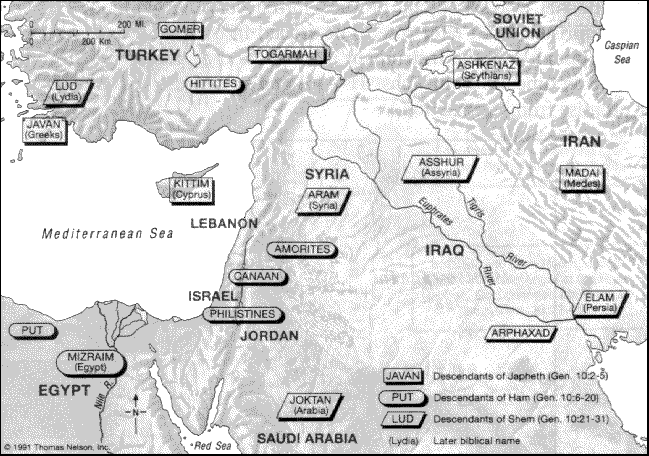
Some initial and helpful maps to introduce the geography and genealogy discussed in Genesis are visible in the following maps from Nelson’s Complete Book of Bible Maps & Charts. The first refers to Genesis 10 and is called the “Table of Nations.” This is structured in terms of the descendants of the three sons of Noah: Japheth (vv. 2–5), Ham (vv. 6–20), and Shem (vv. 21–31). Many names mentioned in chapter 10 are identifiable with nations of ancient times, some of which have continued to the present age. The second refers specifically to the travels of the Patriarchs.
The Nations of Genesis 10
Travels of the Patriarchs
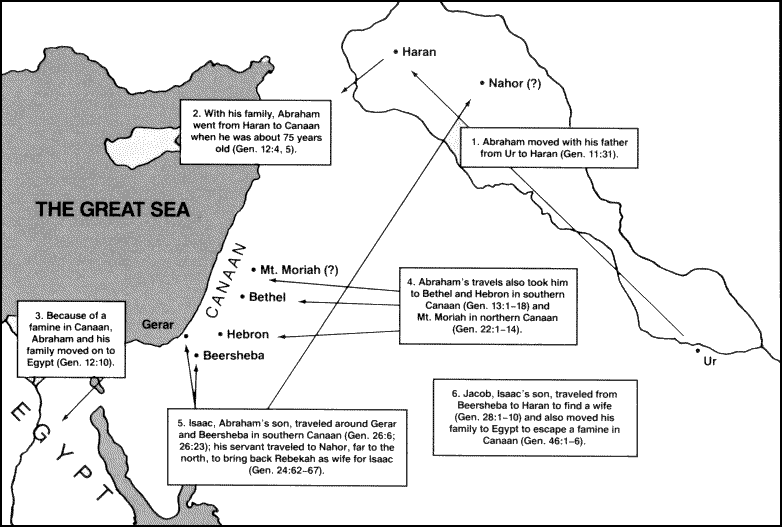
(Further maps will be shared throughout the blogs to assist with visualizing how and where the travels and events occurred.)
Outline
An elementary outline of the book of Genesis would be:
The Primeval History: Creation, sin, the flood, and the early history of the nations (1:1–11:32)
The Patriarchal Narratives (12:1-36:43)
a) The life of Abraham (12:1–25:18)
b) The lives of Isaac and Jacob (25:19–36:43)
The lives of Joseph and his brothers (37:1–50:26)
A more comprehensive one would be:
Part One: Primeval History (1:1–11:9)
The Creation (1:1–2:25)
a) Creation of the World (1:1–2:3)
b) Creation of Man (2:4–25)The Fall (3:1–5:32)
a) The Fall of Man (3:1–24)
b) After the Fall: Conflicting Family Lines (4:1–5:32)The Judgment of the Flood (6:1–9:29)
a) Causes of the Flood (6:1–5)
b) Judgment of the Flood (6:6–22)
c) The Flood (7:1–8:19)
d) Results of the Flood (8:20–9:17)
e) After the Flood: The Sin of the Godly Line (9:18–29)The Judgment on the Tower of Babel (10:1–11:9)
a) Family Lines After the Flood (10:1–32)
b) Judgment on All the Family Lines (11:1–9)
Part Two: Patriarchal History (11:10–50:26)
The Life of Abraham (11:10–25:18)
a) Introduction of Abram (11:10–32)
b) The Covenant of God with Abram (12:1–25:18)The Life of Isaac (25:19–26:35)
a) The Family of Isaac (25:19–34)
b) The Failure of Isaac (26:1–33)
c) The Failure of Esau (26:34, 35)The Life of Jacob (27:1–36:43)
a)Jacob Gains Esau’s Blessing (27:1–28:9)
b)Jacob’s Life at Haran (28:10–32:32)
c) Jacob’s Return (32:1–33:20)
d) Jacob’s Residence in Canaan (34:1–36:43)
e) The History of Esau (36:1–43)The Life of Joseph (37:1–50:26)
a) The Corruption of Joseph’s Family (37:1–38:30)
b) The Exaltation of Joseph (39:1–41:57)
c) The Salvation of Jacob’s Family (42:1–50:26)
(Nelson’s, 1996)
Structure
The book of Genesis contains two primary sections: Genesis 1-11 and 12-50. Genesis 1-11 shares the primeval history, with the creation of the world and the stories of Adam and Eve, the Fall, Cain and Abel, Noah’s ark, and the tower of Babel. Genesis 12-50 consists of the ancestral/patriarchal narratives[1], which begin with Abram (who later became Abraham; see Gen. 17:5) and end with the death of Jacob and his son, Joseph.
Genesis 1-11 sets a foundation for the rest of Genesis and the Pentateuch. We now know what the background of the world is for the people of Israel and how they fit into it. We know that God made the world, humanity sinned and continues to sin, the flood happened, humanity recovered, and separate groups and languages were created (11:7-8).
Genesis 12-50 contains valuable Jewish history and serves as a prologue for the book of Exodus. We find in 11:27-32 that Abram and Sarai are an old couple without children. God, however, tells them to leave the land they are in, and He will bless Abram and make him a great nation (12:1-3; cf. 18:18; 28:14). As the book unfolds, we see that with the covenant in chapter 17, God changes Abram’s name to Abraham (v. 5) and Sarai’s name to Sarah (v. 15). Abraham has a son by Hagar (Sarah’s servant) called Ishmael; however, God’s intention was for Sarah to have a child herself, and his name is Isaac.
Isaac later fathers the twins, Esau and Jacob (25:19-36:43). Jacob (God changes Jacob’s name to “Israel”) then has 12 sons, one of whom is Joseph. After being sold by his brothers to traders, Joseph eventually finds himself in Egypt, where he is later elevated to a powerful position in the royal court after interpreting the Pharaoh’s dream. Pharaoh sees God’s spirit and wisdom in Joseph (41:38-39) and hands him his signet ring (41:42). Joseph performs well for Pharaoh and Egypt, and we later see Joseph reunited with his family in Egypt. Unfortunately, however, their people will later be enslaved (37-50; see Exodus).
Throughout Genesis, the characters face many questions and challenges. God instructs and shows love to His people, but poor decision-making – as well as good decision-making – often proves to have its consequences. The themes of God’s promise and blessing are pronounced in Genesis, as God looks to call His people away from a world and ways plagued by sin and into a life and land where they look to Him for instruction and guidance (cf. Deut. 6:1-25).
Reflective Thoughts to Consider
What is the motivation behind your life story? How are you going to contribute to the storyline of humanity?
Where do you fit in the story? Do you empathise with any particular biblical characters?
What do you learn about God in His actions throughout Genesis?
What connections are there between Jesus and the book of Genesis?
Who or what do you find inspirational in the stories of Genesis?
If you were some of the characters, what would you have done differently, and why? In reflection, try empathising and slipping into their place in history and culture. Would your initial answers to the questions remain the same?
Bibliography
Barry, J. D., Mangum, D., Brown, D. R., Heiser, M. S., Custis, M., Ritzema, E., Whitehead, M. M., Grigoni, M. R., & Bomar, D. (2012, 2016). Faithlife Study Bible. Lexham Press.
Brannan, R., Penner, K. M., Loken, I., Aubrey, M., & Hoogendyk, I., eds. (2012). The Lexham English Septuagint. Lexham Press.
Chavalas, M. W. (2003). Moses. In T. D. Alexander & D. W. Baker (Eds.), Dictionary of the Old Testament: Pentateuch (pp. 570-579). InterVarsity Press.
Hamilton, V. P. (1990). The book of Genesis, chapters 1-17. Wm. B. Eerdmans Publishing Co.
Hoffmeier, J. K. (1979–1988). Moses. In G. W. Bromiley (Ed.), The International Standard Bible Encyclopedia, Revised (Vol. 3, pp. 415-425). Wm. B. Eerdmans.
Kittel, G., Friedrich, G., & Bromiley, G. W. (1985). Génesis. In Theological Dictionary of the New Testament, Abridged in One Volume (pp. 117-119). W.B. Eerdmans.
Longman, T., III. (2005). How to read Genesis. IVP Academic.
Nelson’s complete book of Bible maps & charts: Old and New Testaments (Rev. and updated ed.). (1996). Thomas Nelson.
Turner, L. A. (2003). Genesis, Book Of. In T. D. Alexander & D. W. Baker (Eds.), Dictionary of the Old Testament: Pentateuch. InterVarsity Press.
Youngblood, R. F., Bruce, F. F., & Harrison, R. K., eds. (1995). “Exodus, the”. In Nelson’s new illustrated Bible dictionary. Thomas Nelson, Inc.; Logos Bible Software.